Relationship chat analyzer: reading one side of a pair
A two person chat has two people in it, and the reading that comes back is about one of them. What the published pages say is inferred, what the other side is used for, and the clause that rules out deciding anything.
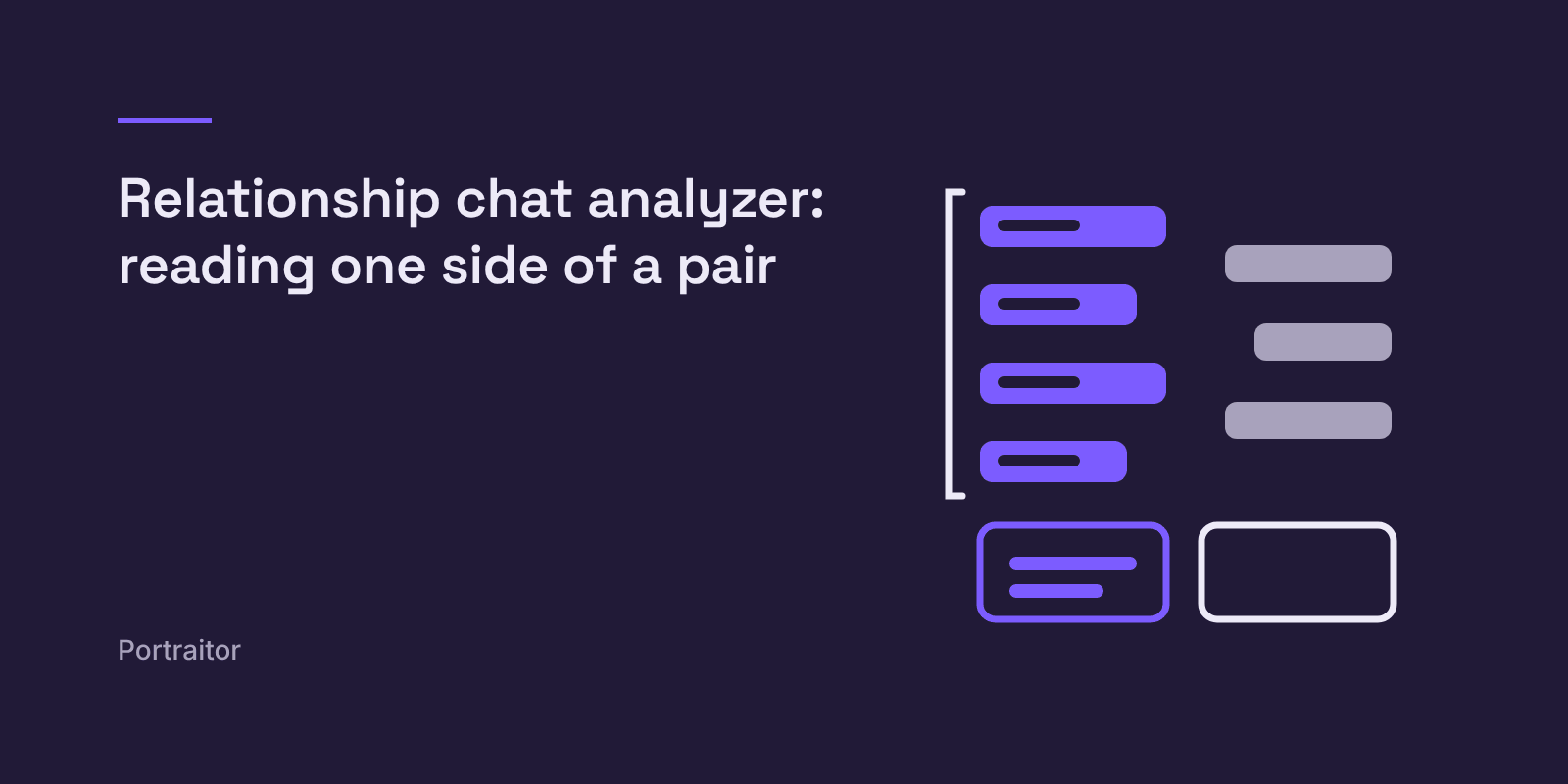
A chat between two people has two people in it, but the reading that comes back names one of them. Portraitor asks which participant you want before it asks for payment, and the other person’s messages are used as context rather than described. That is the shape of the thing, and it decides what the result can honestly be used for.
The phrase relationship chat analyzer suggests a reading of the pair. What these tools actually produce is a reading of one participant, in one span, from written turns. Those are not the same object, and the difference is the whole of what follows.
The portrait is written about one participant, chosen before you pay
Portraitor’s own page asks the question outright at its second step: which person in the conversation do you want to analyze. It tells you to pick the one person you want a portrait of, and says that their messages are read while everyone else stays context. The step after that asks which time period, with presets or a range you drag.
Two consequences follow from that and neither is hidden. The result is attached to a person, not to a pair, so there is no joint score to compare against anyone else’s. And the result is attached to a window, so a different span can produce a different description of the same person without either one being wrong. What narrowing the window does covers that second point, and what picking yourself means covers the case where the participant you choose is you.
What the policy says it infers, and the confidence figure beside each
Portraitor’s privacy policy, version 1.3 of 30 September 2026, sets out what the analysis produces: inferences about a participant in the conversation, including personality traits, attachment and conflict style, emotional regulation, motivations and communication style, each with an estimate of confidence. The policy’s own list continues past those, and it is published in full on that page.
The phrase worth stopping on is the last one. Each item arrives with a confidence estimate attached, which is the policy saying in its own words that these are readings rather than findings. The same section says the inferences are delivered to you alone, that Portraitor does not retain them, that no one there can read them, and that no decision about anyone is made from them by Portraitor or by any system it operates. What comes back in the report shows the shape of that output.
Two people, one reading: what the other side contributes
The other person’s messages are not ignored, because a conversation cannot be read one half at a time. A reply only has a speed if there was something to reply to, and a question only goes unanswered if somebody asked it. The second person supplies the occasions. The description is still written about the participant you picked.
What happens to that second person’s identity is set out separately. The privacy policy says the other participants have not used the service themselves, that their names, email addresses and telephone numbers are removed on your device by the same process before anything is transmitted, and that the list matching each placeholder back to a real detail never leaves your device. It adds that no record of them is held and that nothing about them remains once your portrait has been produced. Uploading a chat someone else is in works through what that means in practice, and group chats extend the same rule past two people.
The clause that rules out using it to decide anything
Portraitor’s terms page, version 1.3 of the same date, says in its acceptable use section that you agree not to use a portrait, or anything derived from one, to make or support a decision about a person’s employment, education, housing, credit, insurance, immigration status, or access to any service or benefit. It states that the service is built for personal reflection and is not designed, tested or suitable for any such purpose, and that you agree not to use it to surveil, stalk, harass or harm anyone.
The same section covers permission. It says you agree not to submit a conversation you do not have permission to read, that before payment you confirm you have that permission, and that you are responsible for the confirmation being true, including obtaining consent where the law of your country requires it. The clauses in full quotes that section as written.
Why no number here is a verdict on a relationship
Put the three pieces together and the limit is structural rather than modest. The input is written turns from one span. The output is a set of inferences about one participant, each carrying a confidence estimate. The terms forbid using any of it to decide anything about a person. There is no step in that chain where a relationship is assessed, and nothing in the published pages claims one.
What is left is still worth something, provided it is described accurately: a written account of how one person came across in a conversation you already had, over a stretch you chose. It is a prompt for your own thinking rather than an answer about anybody. What a chat analysis cannot tell you is the longer list of what sits outside that boundary, and a chat analyzer that reads one person shows the four steps before any payment is taken.
Frequently asked questions
Frequently asked questions
Does a relationship chat analyzer score a relationship?
Portraitor does not produce one. Its page asks which single participant you want a portrait of and says the other people stay as context, and its privacy policy describes the output as inferences about a participant, each with an estimate of confidence. Some other services do present a joint score, and what that score is built from is a question for each one’s own pages.
What does the analysis actually infer about the person?
Portraitor’s privacy policy lists the categories, beginning with personality traits, attachment and conflict style, emotional regulation, motivations and communication style, and says each arrives with an estimate of confidence. The full list is published on that page.
Can I use the result to make a decision about someone?
The terms say no. Their acceptable use section says a portrait, or anything derived from one, must not be used to make or support a decision about a person’s employment, education, housing, credit, insurance, immigration status or access to any service or benefit, and that the service is not designed, tested or suitable for any such purpose.
Do I need the other person’s permission?
The terms say you confirm before payment that you have permission to read the conversation, that you are responsible for that confirmation being true, and that where the law of your country requires the consent of the other participants you must have obtained it.
One person, one span, and a confidence figure beside every line.
One participant, one span
You pick the person and the stretch of time before the payment step, and the people around them stay as context.
See the four steps →